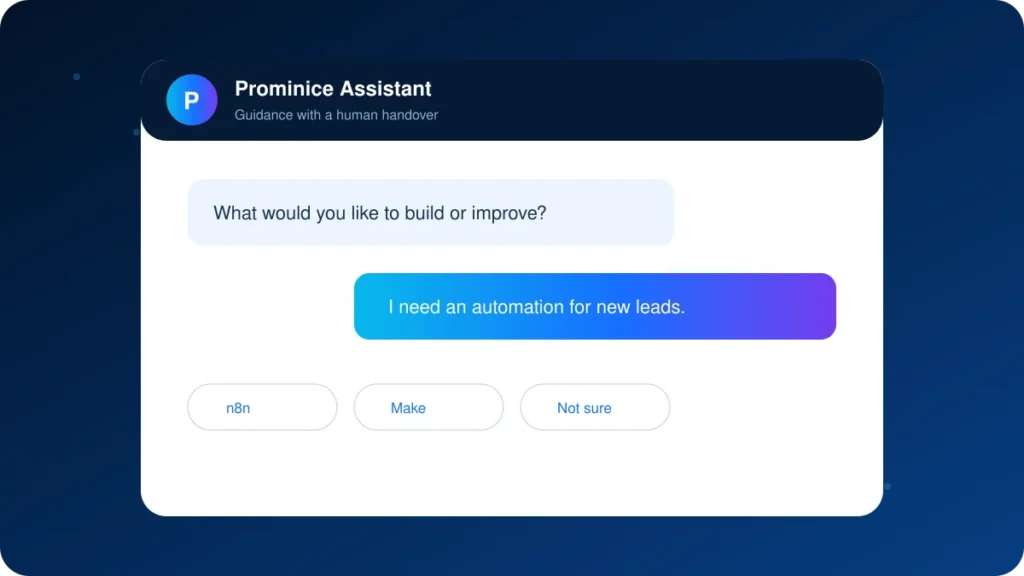
An AI chatbot for lead generation should make the next step clear. A useful website assistant should reduce visitor effort, not trap people inside a scripted conversation. The goal is to help someone understand the next step while collecting only the context needed for a thoughtful human response.
- Choose a narrow and valuable role
- Design transparent conversation paths
- Capture context progressively
- Plan retrieval and answer boundaries
- Build human handover into the journey
- Store, measure and improve conversations
Choose a useful AI chatbot role
An AI chatbot strategy should begin with one useful job, such as helping visitors choose a service or prepare an inquiry. Review the questions your team already receives and identify where a short answer can remove confusion. Define success as a useful next step or qualified inquiry, then test that journey before expanding the assistant into more topics.
What to check
- Choose one visitor goal and one intended next action.
- List questions the assistant can answer from approved content.
- Decide which questions should go directly to a person.
Design transparent conversation paths
Tell visitors that they are speaking with an automated assistant and make the available actions clear. Offer routes for learning about a service, asking a question and contacting a person. Keep a visible way to leave the conversation. If the assistant cannot answer, explain the limitation and offer a direct next step without making the visitor repeat the entire request.
What to check
- Identify the assistant and explain its role.
- Offer a clear contact or exit option.
- Test unclear requests and conversations that change topic.
Capture context progressively
Ask for information when it becomes useful. Start with the service or problem, then collect the project details needed for follow-up. Explain why contact information is requested and let visitors review their details before submission. Avoid asking for passwords, payment details or unrelated personal information in a general lead conversation.
What to check
- Collect only the details needed for the next step.
- Explain the purpose of the contact fields.
- Confirm that the submission reaches the intended team.
Plan retrieval and answer boundaries
Give the assistant an approved set of service descriptions, FAQs and process information. Identify who maintains each source and what should happen when an answer is missing or outdated. An AI chatbot should acknowledge uncertainty instead of inventing a quote, availability or a promise. Test confusing questions and instructions that try to push it beyond its assigned role.
What to check
- Record the approved sources and content owner.
- Define a fallback for missing or conflicting information.
- Review answers after changes to services or policies.
Build human handover into your AI chatbot
Decide which conversations need a person: unusual requirements, complaints, uncertainty or a direct request for help. Include the requested service, relevant context and unanswered question in the handover. Tell the visitor whether they are being transferred now or submitting a request for later follow-up. Use a clear fallback when the team is unavailable.
What to check
- Set handover triggers and a responsible team.
- Include a concise conversation summary.
- Check the out-of-hours response and failure fallback.
Store, measure and improve conversations
Measure whether visitors reach a useful outcome, not only how many conversations start. Review completed inquiries, unanswered questions, handover failures and lead quality. Sample conversations with appropriate access controls and remove unnecessary personal data from reports. Give one owner responsibility for reviewing failures, updating answers and checking that the handover still reaches the right person.
What to check
- Track completed and qualified inquiries separately.
- Review unanswered questions and failed handovers.
- Limit access and define a retention period for conversation records.
Turning the framework into action
A practical plan assigns ownership, timing and measurement to each recommendation. Prominice can help translate the framework into a focused project estimate based on your current systems and goals.
For the workflow behind the assistant, compare n8n, Make and Zapier. Share your services, lead criteria and handover needs in a project estimate request.
Our AI chatbot and workflow automation services connect the assistant brief with data handling, evaluation examples and a defined human follow-up path.